
Let’s start first with the different types of Beaujolais and a quick rundown of them.
There are ten crus In Beaujolais, besides this you’ll find 38 official villages with 12 appellations. This is important to know as you’ll be capable of differentiate these on the label when you’re shopping. All the crus are located on the northern side of Beaujolais. Natural winemaking is an important factor in all these crus.
You’ll hear of the ‘gang of four’ as you dive deeper into Beaujolais. We will go over them more together as we explore the rest of the crus. These are the producers that made natural methods flourish in this area. They helped create strong wines full of complexity.
The real star here is of course the grape itself and that is Gamay. This grape ripens early, has bright acidity, and is light-skinned. It is the heart of Beaujolais and loved for its aromatic charm and fresh, lively personality. You will mostly come across red wines, but there is a small amount of rose made from Gamay and a few whites made from Chardonnay, though those can be a bit tricky to find.
The cru that we will be focusing on today is…
Morgon
Morgon wines have impressive aging potential. They often last up to ten years or even more. This is especially true when crafted with natural winemaking methods. The region’s volcanic soils impart a firm, distinctive minerality, while the wines themselves are known for their fleshy character. The Côte du Py vineyard is famed for producing complex, long-lived bottles. Be sure to look for it on the label if you want to dive into more intense expressions.
Morgon deeply expresses how serious the Gamay grape can be. It is even referred to as “morgonner”. This term describes just how complex it can become with age.
And as with many Beaujolais wines, Carbonic Maceration plays a key role in shaping them.
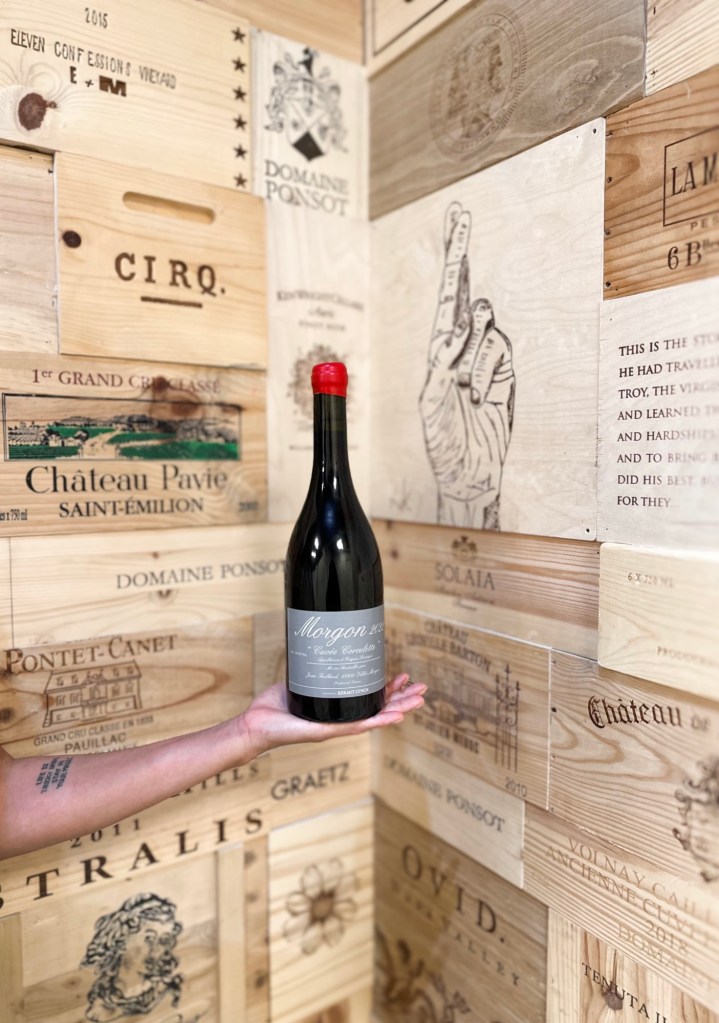
Tasting today is: Morgon ‘Cuvee Corcelette’ by Domaine Jean Foillard
Vintage : 2022

Tasting Notes:
A bright ruby color, this wine has an earthy, aromatic profile with lively acidity. It is fruit forward yet still layered, showing hints of licorice, violet, red cherries, and sage. Floral notes lift the nose, while the palate offers bright, tart acidity and fine, supple tannin’s. It is the wine that makes you want to seek out this vintage again. Let it rest a few more years to see its full potential.
If you enjoy Burgundy wines and Pinot Noir overall then I definitely recommend exploring Morgon wines.
This bottle had everything I was hoping for when I first started exploring Beaujolais crus. In this bottle, I found that showstopper of texture. It was almost like chewy candy but with way more depth. It was a wonderful experience.
Tip: I’d recommend decanting, especially if the wine from this cru is young. I decanted for about 35 minutes. I tasted the wine throughout this time frame and the end result made me stop the decanting to fully taste.
Food Pairing: With Thanksgiving coming around the corner, consider the crus of Beaujolais as they make a great pairing for turkey.
The other crus that we will soon be exploring are Moulin-à-Vent, Fleurie, Chiroubles, St. Amour, Julienas, Chenas, Regnie, Brouilly, and Côte de Brouilly.
Cheers!
-Crimson & Cork

 Crimson & Cork
Leave a comment